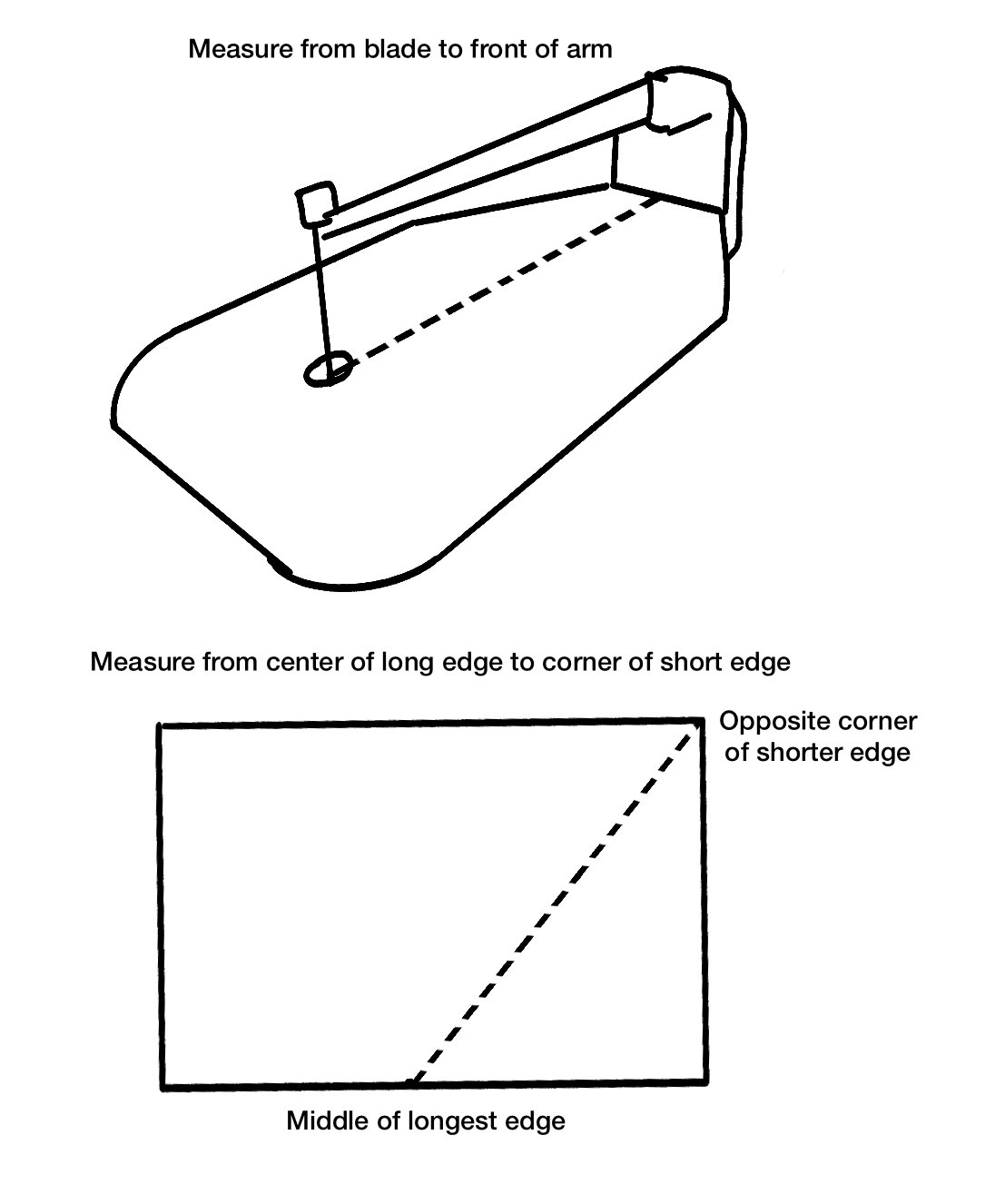
If you have a large puzzle that you are not sure you will be able to cut in half on a saw, you can use math to figure it out.
First, measure your saw from the blade to the front of the arm. Then measure the puzzle from the middle of the long edge to the opposite corner and calculate 75% of the puzzle measurement you’ve taken.
The 75% puzzle measurement should be less than the measurement on your saw to ensure you have enough room to rotate the puzzle around the blade, assuming you section it into roughly two pieces by starting your cut from very near the middle of the longest edge of the puzzle.
Note that the 75% calculation gives you some “wiggle room” to wander the first cut a bit across the puzzle. If you plan to do the first cut with a knob pattern that goes pretty much straight across the puzzle, then you may be able to squeeze the calculation to 90% of the puzzle measurement. If you want more room to wander the first cut, then you may need to use 70% or even less.
Another thing to consider when cutting down large puzzles is the length of your arms and your comfort in stretching and spinning the puzzle around the blade, including chatter from wood warpage. I find that drastically lowering the speed of the blade helps to control the first cut.